How to choose the Right Adhesives for electronic components?
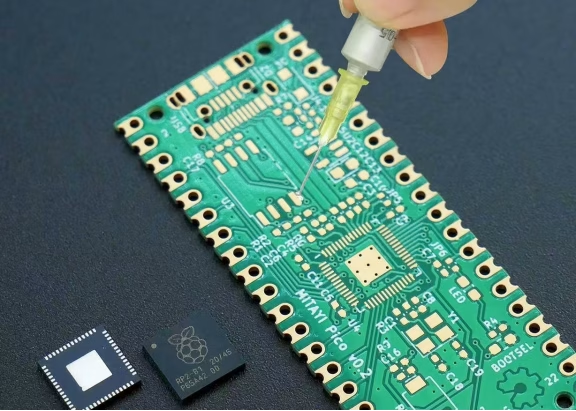
Table of Contents
1. The Unsung Heroes of Electronics
In the intricate world of modern electronics, where devices shrink in size yet expand in functionality, every component plays a crucial role. Often overlooked, but undeniably critical, are the adhesives that bind, protect, and enhance the performance of these sophisticated systems. From holding delicate Surface Mount Devices(SMDs) in place during manufacturing to providing vital thermal management and environmental protection, the right choice of electronic components adhesives is paramount for reliability and longevity.
Choosing the correct adhesive isn’t a one-size-fits-all decision; it requires a deep understanding of material science, application demands, and environmental factors. This comprehensive guide will delve into the various types of adhesives, outline the crucial criteria for how to match adhesives to specific applications, explore their indispensable role in SMT assembly, highlight common challenges of adhesives, and showcase the vast applications of adhesives in electronics manufacturing.
2. The Critical Role of Adhesives in Electronics

Modern electronic devices face demanding conditions, from extreme temperatures and humidity to constant vibration and chemical exposure. Adhesives serve multiple vital functions that extend beyond mere bonding, acting as critical enablers for device performance and durability:
- Mechanical Support:They physically secure components, wires, and substrates, preventing movement and ensuring structural integrity, especially under vibration or impact.
- Electrical Management:Adhesives can be formulated to be electrically insulating, preventing short circuits, or electrically conductive, providing grounding or replacing solder in certain applications.
- Thermal Management:Thermally conductive adhesives facilitate heat dissipation, bonding heat sinks to components to prevent overheating and extend component life.
- Environmental Protection:They seal against moisture, dust, and chemicals, protecting sensitive circuitry from degradation and corrosion. Potting and encapsulation provide robust protection against harsh environments.
- Stress Relief:Flexible adhesives can absorb mechanical and thermal stresses, preventing damage to delicate components and solder joints, particularly in applications with mismatched Coefficients of Thermal Expansion(CTE).
3. Understanding Different Types of Electronic Adhesives

The vast array of electronic applications has led to the development of specialized types of adhesives, each with unique properties. Understanding these differences is fundamental to making an informed choice:
1) Epoxy Adhesives
Epoxies are among the most versatile and widely used adhesives in electronics. Known for their high bond strength, rigidity, chemical resistance, and excellent electrical insulation properties, they are often used for structural bonding, potting, and encapsulation. They come in one-part(heat-cured) and two-part(room temperature or heat-cured) formulations.
2) Silicone Adhesives
Silicones are celebrated for their exceptional flexibility, wide operating temperature range (-60°C to over 200°C), and superior moisture and chemical resistance. Their elasticity makes them ideal for applications requiring stress relief, vibration dampening, sealing, and conformal coatings. They also offer good thermal conductivity in specialized formulations.
3) Polyurethane Adhesives
Polyurethanes offer a balance of flexibility, toughness, and excellent adhesion to a variety of substrates. They are commonly used for potting, encapsulation, and sealing applications where good impact resistance and flexibility are required, often providing better reworkability than some epoxies.

4) Acrylic Adhesives
Acrylics are known for their fast curing times, strong adhesion to many plastics, and good environmental resistance. UV-curable acrylics are particularly popular in high-volume manufacturing due to their rapid, on-demand curing, which significantly speeds up production processes.
5) Specialty Adhesives for Advanced Applications
- Electrically Conductive Adhesives(ECAs):Formulated with conductive fillers(e.g., silver, carbon), ECAs provide electrical pathways, serving as alternatives to solder for sensitive components, EMI shielding, and grounding applications.
- Thermally Conductive Adhesives(TCAs):Loaded with thermally conductive fillers (e.g., ceramic, aluminum nitride), TCAs are crucial for thermal management, effectively transferring heat from hot components to heat sinks.
- UV-Curable Adhesives:Offering instant cure on demand when exposed to UV light, these adhesives are excellent for high-speed assembly processes where precision and rapid setting are essential.
Here’s a quick comparison of common types of adhesives:
| Adhesive Type | Key Characteristics | Primary Applications |
| Epoxy | High strength, rigid, chemical/solvent resistance, good insulation | Structural bonding, potting, encapsulation, glob topping |
| Silicone | Flexible, wide temp range, moisture resistance, vibration dampening | Sealing, conformal coating, thermal interface, stress relief |
| Polyurethane | Flexible, tough, good adhesion, impact resistance | Potting, encapsulation, cable bonding, sealing |
| Acrylic | Fast curing (incl. UV), good adhesion to plastics, solvent resistance | Component bonding, tacking, displays, rapid assembly |
| Electrically Conductive(ECA) | Electrical conductivity, low stress, solder alternative | EMI shielding, grounding, die attach, flexible circuits |
| Thermally Conductive(TCA) | High thermal conductivity, heat dissipation, electrical insulation | Heat sink bonding, LED assembly, thermal management |
4. How to Match Adhesives to Your Application: Key Selection Criteria
The process of how to match adhesives for electronic components is a critical engineering decision. It involves a systematic evaluation of various factors:
4.1 Substrate Compatibility
The adhesive must bond effectively to the materials it connects(e.g., FR-4, ceramics, metals, plastics like ABS or polycarbonate). Surface energy, cleanliness, and porosity of the substrates all play a role in adhesion strength.
4.2 Operating Environment
- Temperature Range:The adhesive must perform reliably across the full operating temperature range of the device, from extreme cold to high heat.
- Humidity and Moisture:Devices exposed to moisture require adhesives with excellent hydrolytic stability and moisture barrier properties.
- Chemical Exposure:Resistance to oils, solvents, cleaning agents, and other chemicals is vital for long-term reliability.
- Vibration and Shock:For applications subject to mechanical stress, flexible and tough adhesives are preferred to absorb energy and prevent fatigue failure.
4.3 Performance Requirements
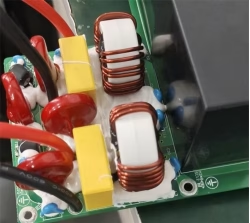
- Mechanical Strength: Evaluate required shear, peel, and tensile strength to ensure components remain securely bonded.
- Electrical Properties:Determine if insulation(high dielectric strength) or conductivity is needed.
- Thermal Properties:Assess the need for thermal conductivity(for heat dissipation) or thermal expansion compatibility(to minimize stress).
- Flexibility/Rigidity:Some applications demand rigid structural bonds, while others benefit from flexible bonds that accommodate movement and thermal cycling.
4.4 Curing Mechanism and Process Compatibility
Consider the production environment: heat curing, UV curing, or room temperature curing. Faster curing methods often accelerate throughput, but require compatible equipment and may have limitations for shadowed areas(UV cure).
4.5 Application Method and Reworkability
The chosen adhesive must be suitable for the dispensing method(e.g., syringe, jetting, screen printing) and allow for efficient rework or repair if necessary, without damaging components.
4.6 Cost and Regulatory Compliance
While performance is key, cost-effectiveness is always a factor. Additionally, ensure compliance with industry standards and regulations such as RoHS, REACH, and UL ratings.
5. Adhesives in SMT Assembly and Advanced Packaging
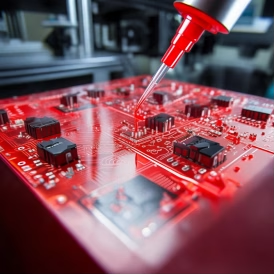
SMT assembly revolutionized electronics manufacturing, and adhesives are integral to its success. In this context, adhesives perform specific, critical roles:
- Component Bonding for Wave Soldering:For components on the bottom side of a PCB that undergoes wave soldering, adhesives temporarily hold them in place to prevent displacement or falling off before the solder joints are formed.
- Underfill Materials:For advanced packages like BGA(Ball Grid Array), CSP(Chip Scale Package), and flip-chip, underfill adhesives fill the gap between the chip and the substrate. This mitigates stress caused by the mismatch in Coefficients of Thermal Expansion(CTE) between the chip and the PCB, significantly improving the reliability and drop test performance of the device.
- Encapsulation and Glob Topping:Adhesives are used to protect bare die on PCBs(glob topping) or to fully encapsulate entire modules(potting), shielding them from moisture, contamination, and mechanical shock.
6. Common Challenges and Solutions in Adhesive Application
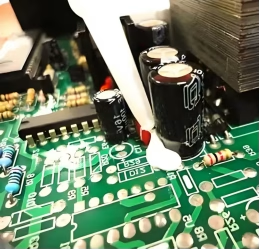
Despite their benefits, the use of adhesives in electronics presents several common challenges of adhesives that must be addressed for optimal performance:
1) Adhesion Failure: This is often due to improper surface preparation(contaminants, low surface energy), incorrect adhesive selection for the substrate, or inadequate curing.
Solution: Ensure thorough surface cleaning(plasma treatment, solvent wipes), select adhesives proven for specific substrates, and strictly follow curing profiles.
2) Thermal Stress and CTE Mismatch: Different materials expand and contract at different rates with temperature changes, leading to stress on adhesive bonds and components.
Solution: Utilize flexible adhesives(like silicones or polyurethanes) or underfills to absorb stress. Choose adhesives with a CTE closely matched to the components or substrate.
3) Moisture Ingress: Moisture can degrade adhesive properties, lead to delamination, and cause corrosion of electronic circuits.
Solution: Employ moisture-resistant adhesives, ensure complete encapsulation/sealing, and control environmental humidity during assembly and storage.
4) Dispensing Accuracy: Precise application of tiny adhesive dots or beads is crucial for miniaturized components. Inaccurate dispensing can lead to insufficient bond strength or unintended short circuits.
Solution: Invest in automated, high-precision dispensing equipment, and regularly calibrate systems.
5) Reworkability: Some strong adhesives can make component rework or repair difficult, potentially damaging the PCB or surrounding components.
Solution: Consider adhesives designed for rework (e.g., heat-releasable epoxies) or evaluate the overall repair strategy upfront.
7. Diverse Applications of Electronic Adhesives
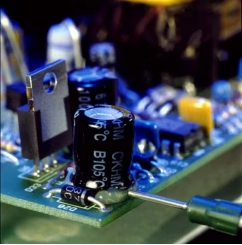
The applications of adhesives in electronics are incredibly varied, spanning across virtually every type of electronic device:
- Component Bonding:Securing resistors, capacitors, LEDs, sensors, and ICs to PCBs.
- Wire Tacking and Coil Bonding: Anchoring fine wires, delicate coils, and cable harnesses to prevent movement and damage.
- Potting and Encapsulation:Protecting entire circuits, sensors, or modules from environmental hazards, vibration, and tampering.
- Conformal Coatings:Thin adhesive layers applied over PCBs to protect against moisture, dust, and chemical contaminants.
- Thermal Interface Materials(TIMs) and Heat Sink Bonding:Using thermally conductive adhesives to bond heat sinks to processors, power modules, and LEDs, improving heat transfer.
- EMI/RFI Shielding:Electrically conductive adhesives are used to create conductive pathways for grounding or to form shielding gaskets against electromagnetic interference.
- Structural Reinforcement:Bonding and reinforcing housing components, display panels, and connectors.
- Die Attach:Securing semiconductor dies to leadframes or substrates in package manufacturing.
8. Electronic Components Adhesive FAQs
Electrically Conductive Adhesives(ECAs) are designed to provide an electrical pathway, often used for grounding or as solder alternatives. Thermally Conductive Adhesives(TCAs) are designed to transfer heat efficiently away from components, typically used for bonding heat sinks, and are usually electrically insulating.
While cyanoacrylates offer instant bonding, they are generally not recommended for long-term electronic applications due to their brittleness, poor resistance to humidity, limited temperature range, and potential for “blooming” (white residue) which can be conductive or corrosive. Specialized electronic-grade adhesives are far more reliable.
Extremely critical. Proper surface preparation (cleaning, roughening, priming) ensures optimal adhesion. Contaminants like oils, dust, or mold release agents can severely compromise bond strength, leading to premature failure.
Underfill is an adhesive material applied in the gap between a chip (like a BGA or flip-chip) and its substrate. Its importance lies in mitigating stress caused by the difference in Coefficients of Thermal Expansion(CTE) between the chip and the PCB, significantly enhancing the reliability and mechanical robustness of the solder joints during thermal cycling and drop events.
9. Summary
The selection of the right adhesives for electronic components is a multifaceted decision profoundly impacting the performance, reliability, and lifespan of electronic devices. It moves beyond simple bonding, encompassing critical functions like thermal management, electrical insulation or conductivity, and environmental protection. By carefully considering the various types of adhesives available, evaluating specific application requirements, and understanding the nuances of how to match adhesives to substrates and operating conditions, manufacturers can overcome common challenges of adhesives and leverage their full potential across a myriad of applications of adhesives.
From the high-volume precision of SMT assembly to the demanding requirements of advanced packaging and robust environmental sealing, adhesives are indispensable enablers of modern electronic innovation. A well-informed choice ensures not just a secure bond, but a foundation for enduring electronic excellence.
Contact us
WhatsApp: +86-13570802455
Wechat: +86-13570802455
Email: [email protected]