PCBA Controller Guide: Types, Components & Applications
Table of Contents
Ever wondered what makes your smartphone respond to your touch, your smart thermostat regulate temperature, or your microwave cook food with precision? Behind every modern electronic device, from the simplest gadget to complex industrial machinery, lies an invisible commander: the PCBA controller. These sophisticated components are the unsung heroes, orchestrating the myriad of operations that bring our technology to life. They are, quite literally, the brains behind the hardware, managing everything from basic electrical signals to complex programmed instructions.
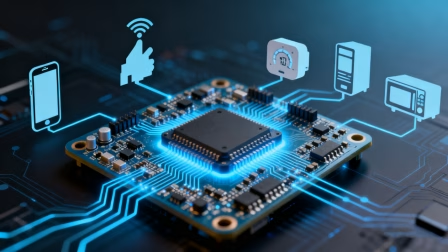
In today’s interconnected world, understanding the core control circuit in an assembled printed circuit board (PCB) is more crucial than ever. This comprehensive guide will demystify the world of PCBA controllers, exploring their fundamental role, the different types available, their essential components, critical design considerations, and their diverse applications. Whether you’re an aspiring engineer, a hobbyist, or simply curious about the electronics that power your world, this article will provide you with everything you need to know about these indispensable integrated circuits.
1. What is a PCBA Controller?
A PCBA controller is essentially an electronic circuit or an integrated circuit (IC) that acts as the “brain” of a printed circuit board. Its primary role is to control and coordinate the various functions and operations of the board and the device it powers. Think of it as the central nervous system of an electronic system, receiving inputs, processing information, and generating appropriate outputs to direct other components.
These crucial components manage electrical signals, execute programmed instructions, and facilitate communication between different parts of a system. For instance, in a smart device, the PCBA controller might receive input from sensors (like a touchscreen or an accelerometer), process that data according to its embedded firmware, and then send commands to output components (such as a display, speaker, or motor). Without a robust PCBA controller, even the most advanced hardware would be nothing more than a collection of inert components.
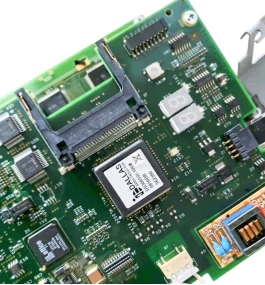
The ubiquity of these controllers highlights their importance in modern electronics. From laptops and smartphones to industrial automation systems and IoT devices, PCBA controllers are the foundation upon which functionality is built. Their design complexity directly impacts a device’s reliability, performance, and longevity, making their selection and implementation a critical aspect of electronic engineering.
2. What are the Types of PCBA Controllers?
While the fundamental purpose of a PCBA controller remains consistent, their implementation can vary significantly depending on the application’s complexity, performance requirements, and cost constraints. Three main types dominate the landscape:
Microcontrollers (MCUs)
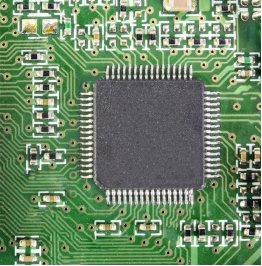
Microcontrollers are the most common type of PCBA controller, essentially a compact computer on a single IC. They integrate a processor core (CPU), memory (RAM, ROM, or Flash), and programmable input/output (I/O) peripherals on a single chip. MCUs are designed to execute specific control tasks and are ideal for embedded systems that require dedicated functionality with moderate processing power. Examples include controlling home appliances, automotive systems, and simple IoT devices. Their cost-effectiveness, ease of programming, and wide availability make them a popular choice for many applications.
Field-Programmable Gate Arrays (FPGAs)
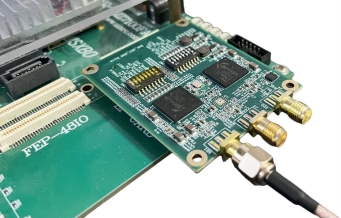
FPGAs are different from MCUs in that they don’t have a fixed processor architecture. Instead, they consist of configurable logic blocks and programmable interconnects, allowing engineers to design and implement custom digital circuits. This reconfigurability means FPGAs can perform highly parallel operations and are excellent for tasks requiring high-speed data processing, real-time control, and complex signal processing. They are commonly found in telecommunications, aerospace, and high-performance computing, where flexibility and speed are paramount. While more expensive and complex to program than MCUs, their adaptability is unmatched.
Application-Specific Integrated Circuits (ASICs)
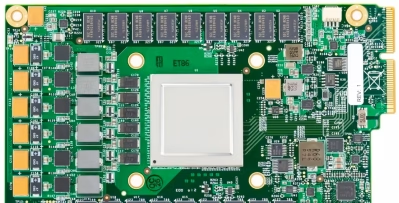
ASICs are custom-designed integrated circuits tailored for a very specific application. Unlike MCUs and FPGAs, which are general-purpose to some extent, an ASIC is optimized for a single function. This specialization allows ASICs to achieve the highest possible performance, power efficiency, and smallest form factor for their intended task. However, the non-recurring engineering (NRE) costs for designing and fabricating an ASIC are exceptionally high, making them economically viable only for very high-volume production or highly specialized, critical applications (e.g., advanced processors, graphics cards, custom control processor chips in niche industries).
Here’s a comparison of these controller types:
| Feature | Microcontroller (MCU) | Field-Programmable Gate Array (FPGA) | Application-Specific Integrated Circuit (ASIC) |
| Flexibility | High (software programmable) | Very High (hardware reconfigurable) | Low (fixed hardware design) |
| Performance | Moderate | High (parallel processing) | Highest (highly optimized) |
| Cost (per unit) | Low | Medium to High | Low (at very high volumes) |
| Development Cost/Time | Low/Short | Medium/Medium | Very High/Long |
| Power Efficiency | Moderate | Medium (depends on design) | Highest |
| Typical Use Cases | Home appliances, IoT, simple embedded systems | Telecommunications, signal processing, high-speed interfaces | Smartphones, CPUs, specialized industrial control, very high-volume products |
3. Key Components and Functions of PCBA controllers
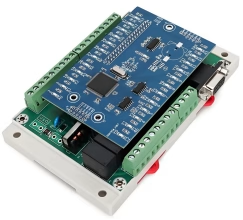
Regardless of their type, most PCBA controllers share a common set of functional blocks that enable them to perform their control tasks. Understanding these components is key to appreciating how a controller operates:
Inputs and Outputs (I/O)
The I/O pins are the interface between the controller and the outside world. Inputs receive electrical signals from various sensors (temperature, pressure, light, etc.), switches, or other components. Outputs send signals to activate actuators (motors, relays), light LEDs, drive displays, or communicate with other circuits. These signals often involve digital HIGH/LOW states or analog voltage levels.
Processing Unit (CPU/Logic)
This is the core “brain” of the controller. In MCUs, it’s typically a Central Processing Unit (CPU) that executes programmed instructions fetched from memory. In FPGAs, this role is filled by configurable logic blocks that implement the desired digital circuit functions. The processing unit interprets incoming data, performs calculations, and makes decisions based on the embedded software or hardware configuration.
Memory
Controllers rely heavily on different types of memory:
- Program Memory (Flash/ROM):Stores the firmware or software instructions that the controller executes. This memory is typically non-volatile, meaning it retains its data even when power is removed.
- Data Memory (RAM):Used for temporary storage of data during program execution, such as variables, buffers, and stack information. This is volatile memory, losing its contents when power is off.
Communication Interfaces
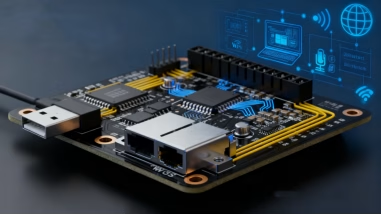
To interact with other devices and components, PCBA controllers incorporate various communication interfaces. Common examples include:
- UART (Universal Asynchronous Receiver/Transmitter):For serial communication with other ICs or computers.
- SPI ( Serial Peripheral Interface):A high-speed, synchronous serial data link primarily used for short-distance communication between MCUs and peripherals (like sensors, external memory, or displays).
- I2C (Inter-Integrated Circuit):A two-wire serial bus commonly used for connecting low-speed peripheral ICs to MCUs.
- USB (Universal Serial Bus):For connecting to host computers or other USB-enabled devices.
- Ethernet/Wi-Fi/Bluetooth:For network connectivity, especially in IoT systems.
These components work in concert, allowing the PCBA controller to effectively manage electrical signals, process data, and coordinate operations across an entire electronic system.
4. Design Considerations for PCBA Controllers
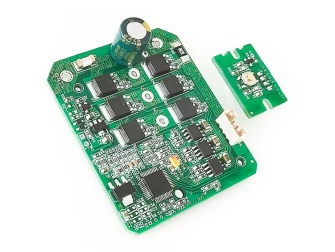
Designing with PCBA controllers involves a delicate balance of various factors. Engineers must carefully evaluate several key design considerations to ensure the final product meets its performance, cost, and reliability objectives:
Performance vs. Cost
This is often the most critical trade-off. A more powerful controller (e.g., a high-end MCU or an FPGA) offers greater processing speed and capabilities but comes at a higher unit cost. Engineers must select a controller whose performance is adequate for the application without over-specifying and driving up expenses. Balancing cost vs performance is crucial for market competitiveness.
Power Consumption
For battery-powered devices or systems with strict energy efficiency requirements, power consumption is paramount. Low-power MCUs are specifically designed for such applications, offering various sleep modes and efficient processing to extend battery life. High-performance FPGAs or ASICs, while powerful, might consume significantly more energy.
Size and Form Factor
The physical size of the controller IC and its associated components directly impacts the overall size of the PCBA. In compact devices like wearables or small IoT sensors, miniature packages and high integration are essential. This influences component selection and PCB layout, which are critical design considerations.
Software and Firmware Development
The complexity of developing software or firmware for the controller is a significant factor. MCUs typically have established development environments and extensive community support, making programming relatively straightforward. FPGAs, requiring hardware description languages (like VHDL or Verilog), demand specialized skills. ASICs, being custom-designed, involve the most intensive design verification and software development efforts.
Thermal Management
Powerful controllers generate heat. Adequate thermal management, through proper PCB layout, heat sinks, or active cooling, is necessary to prevent overheating and ensure long-term reliability. This is particularly important for high-performance applications that push the limits of controller capabilities.
Environmental Considerations
The operating environment dictates specific requirements. Controllers for industrial machines or automotive applications need to withstand extreme temperatures, vibrations, and humidity, often requiring specialized, robust components and packaging. Consumer electronics, while less demanding, still need to meet certain standards for temperature and humidity tolerance.
5. What are the Applications of PCBA Controllers?
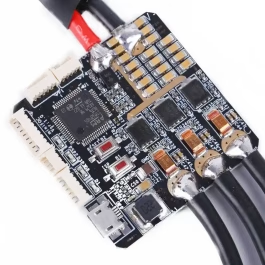
The versatility of PCBA controllers means they are found in almost every electronic device and system imaginable. Here are just a few examples of their diverse applications:
- Consumer Electronics:Smartphones, tablets, smart TVs, washing machines, refrigerators, smart home devices (thermostats, lighting controls), and remote controls all rely on PCBA controllers (typically MCUs) to manage their various functions and user interfaces.
- Automotive Industry:Modern vehicles are packed with control processor chips. PCBA controllers manage engine control units (ECUs), anti-lock braking systems (ABS), airbag deployment, infotainment systems, advanced driver-assistance systems (ADAS), and even electric vehicle battery management systems.
- Industrial Automation:In factories, controllers are critical for programmable logic controllers (PLCs), robotic arms, motor control systems, and automated testing equipment. FPGAs often play a role in high-speed data acquisition and real-time process control.
- Internet of Things (IoT):From smart sensors monitoring environmental conditions to wearable fitness trackers, IoT systems heavily depend on low-power MCUs to collect data, process it, and communicate wirelessly with other devices or cloud platforms.
- Medical Devices:Life-saving equipment like pacemakers, infusion pumps, diagnostic imaging machines, and patient monitors use highly reliable PCBA controllers (often specialized ASICs or robust MCUs) to ensure precise operation and patient safety.
- Telecommunications:Network routers, switches, base stations, and other communication infrastructure utilize FPGAs and ASICs for high-speed data routing, signal processing, and protocol management.
These examples highlight how PCBA controllers are indispensable for bringing intelligence and functionality to hardware across countless industries, making them truly essential components of modern electronics.
6. PCBA Controller FAQs
An MCU (Microcontroller) is a fixed-architecture processor that executes software instructions sequentially. An FPGA (Field-Programmable Gate Array) consists of configurable logic blocks that allow you to design custom hardware circuits, enabling parallel processing and high-speed, custom logic operations.
PCBA controllers are called the “brains” because they perform the critical functions of receiving inputs (from sensors, switches), processing information, making decisions based on programmed instructions, and then generating outputs to control other components of the electronic device. They orchestrate all the operations, much like a brain manages bodily functions.
Yes, many PCBA controllers, especially microcontrollers, are designed to be programmable by users. Using development boards (like Arduino or Raspberry Pi Pico) and integrated development environments (IDEs), hobbyists and engineers can write firmware to control the behavior of the controller and its connected components.
7. Summary
PCBA controllers are the indispensable core components that drive virtually all modern electronic devices. Acting as the “brain” of a printed circuit board, they manage electrical signals, execute programmed instructions, and coordinate operations between various components. We explored three primary types: Microcontrollers (MCUs) for general-purpose embedded tasks, Field-Programm able Gate Arrays (FPGAs) for reconfigurable high-speed applications, and Application-Specific Integrated Circuits (ASICs) for highly optimized, mass-produced solutions.
Understanding their key components—I/O, processing units, memory, and communication interfaces—reveals how they transform inputs into intelligent outputs. Crucial design considerations such as performance vs. cost, power consumption, size, software development, and thermal management are vital for successful implementation. From consumer gadgets to complex industrial machines and IoT systems, PCBA controllers are foundational to innovation, embodying the engineering magic that powers our increasingly connected world.
Key Takeaways
- PCBAcontrollers are the core integrated circuits that manage and coordinate all operations on a PCBA, acting as the “brain”.
- Microcontrollers (MCUs) are versatile, cost-effective for most embedded systems, integrating CPU, memory, and I/O.
- FPGAs offer hardware reconfigurability for high-speed, parallel processing and complex logic, ideal for specialized tasks.
- ASICs provide maximum performance and efficiency for specific functions but require significant upfront investment and high production volumes.
- Key components include I/O pins for input/output, a processing unit for execution, various memory types, and communication interfaces for device interaction.
- Critical design considerations involve balancing performance with cost, power consumption, physical size, software development complexity, and thermal management.
- PCBAcontrollers are ubiquitous, found in consumer electronics, automotive systems, industrial automation, IoT devices, and medical equipment.
Contact us
WhatsApp: +86-13570802455
Wechat: +86-13570802455
Email: [email protected]